
Closer Than Shame
Genesis 3: Even in humanity’s worst moment, God moved toward, not away.

Genesis opens with a beautiful picture of how the world can and should be—but if we’re honest, the world isn’t always that way.
I started using drugs at 12, and by 20 I was arrested and thrown in jail. But I remember these vivid moments of closing my eyes and imagining a wide field—wildflowers, blue skies, big fluffy clouds. Almost like a moor around me, warm wind and a hazy glow. Considering I was in the darkest place imaginable, where does this kind of fantasy for a beautiful world come from? I couldn’t make sense of it.
After jail I went straight to rehab, and in rehab I had counseling that changed how I saw everything. One day the therapist had us close our eyes. While they were closed, she quietly took something from the room and hid it. When we opened our eyes, she asked, “What’s missing?” We all noticed right away—she took the book off the table. Then she said, “But if you’d never seen the full picture, how would you know what’s missing?”
That’s what the Bible is like. It gives us the full picture, so when we look at the world now—not quite right, confused, longing for more—we understand what’s missing, and where it all began.
Shameless to Hiding (Genesis 3:1-13, NIV)
Genesis 1 and 2 open with this picture of how the world should be. It’s beautiful—like the kind of world we all dream about. You’ve got this garden, and this man and woman walking with God, enjoying each other and everything around them. There’s no hiding, no shame, no tension—just peace.
Chapter 2 literally ends with this line: “They were naked and felt no shame.” That’s how complete their trust was—with each other, and with God.
But just one verse later, the story takes a darker turn.
Now the serpent was more crafty than any of the wild animals the Lord God had made. He said to the woman, “Did God really say, ‘You must not eat from any tree in the garden’?”
We have to pause here. I didn’t grow up reading the Bible. I mostly just absorbed whatever people around me said about religion. And even now, when I read this, I get hung up. I mean, come on—a talking snake? Really? It sounds like something out of a children’s book or a myth.
But here’s the thing: sometimes we hit a confusing part of Scripture because we’re stepping into the middle of a story that started long before us. That’s what’s happening here. Genesis doesn’t stop to explain it. It doesn’t say, “And one day, a snake started talking.” It just drops him in—like we’re supposed to already know there’s more happening behind the scenes.
It’s assuming something—that there’s not just a physical world, but a spiritual one too. Something unseen that’s already been in motion before humanity ever came on the scene.
When you start a new book, have you ever read the last chapter first to get a sense of where things are heading? That’s kind of what we have to do here to make sense of it. So fast forward to Revelation 12, that same serpent is called “the ancient serpent… the devil, Satan, the deceiver of the whole world.” So this isn’t just a clever animal—it’s a spiritual being, working through one.
For Reflection: What might be reasons people today only believe in what they can see? And on the flip side, what are some reasons to believe there’s something more—something beyond the visible world?
Once we can accept the possibility that there’s a spiritual reality—that maybe there really is more than what meets the eye—the next question becomes: Who is Satan?
To understand who he is, the Bible explains more about his story and character.
In Isaiah 14:12–15, we learn that Satan wasn’t content to serve under God—he wanted to be God. His pride led to rebellion, and that’s where his downfall began.
In John 8:44 Jesus says, “He was a murderer from the beginning… the father of lies.” That verse shows us Satan’s true nature—he’s a deceiver. His goal isn’t just to get us to do wrong; it’s to make us distrust God. His lies are always aimed at twisting truth just enough to make us question God’s goodness and doubt His heart.
Together they reveal that the serpent in Genesis 3 isn’t just a talking animal—it’s pride, corruption, and deception taking shape in one voice asking, “Did God really say…?”
But he’s not really asking. He’s accusing. “Maybe God isn’t as good as He says He is. Maybe He’s holding something back from you.”
So, how do they respond?
The woman said to the serpent, “We may eat fruit from the trees in the garden, but God did say, ‘You must not eat fruit from the tree that is in the middle of the garden, and you must not touch it, or you will die.’”
“You will not certainly die,” the serpent said to the woman. “For God knows that when you eat from it your eyes will be opened, and you will be like God, knowing good and evil.”
When the woman saw that the fruit of the tree was good for food and pleasing to the eye, and also desirable for gaining wisdom, she took some and ate it. She also gave some to her husband, who was with her, and he ate it. Then the eyes of both of them were opened, and they realized they were naked; so they sewed fig leaves together and made coverings for themselves.
Then the man and his wife heard the sound of the Lord God as he was walking in the garden in the cool of the day, and they hid from the Lord God among the trees of the garden. 9 But the Lord God called to the man, “Where are you?”
He answered, “I heard you in the garden, and I was afraid because I was naked; so I hid.”
And he said, “Who told you that you were naked? Have you eaten from the tree that I commanded you not to eat from?”
The man said, “The woman you put here with me—she gave me some fruit from the tree, and I ate it.”
Then the Lord God said to the woman, “What is this you have done?”
The woman said, “The serpent deceived me, and I ate.”
I hate everything about this. An embarrassing fact about me. If I am watching a movie and it starts to get tense I will do one of two things. I will close my eyes and cover my face until its over. Or I will just stop watching it. I don’t know what’s worst me staying and screaming the entire time (yes, I did accidentally bloody a boyfriend’s nose because I’m a flailer) or starting so many shows and not finishing them. It’s always at the point where you know the person is about to have an affair or ruin something so good.
That’s what makes this moment so painful. You can almost feel the tension build—the point where everything good is about to unravel. Leading up to this point Adam and Eve had a secure relationship with God, but at the first opportunity, they didn’t run to Him. They could have so easily fact checked. Or even paused. But no, Satan’s temptation was crafty enough to convince them that the fruit, once off-limits for their good, now looks like the one thing that will make life complete.
And that’s the tragedy—you can almost see them reaching for what looks good in the moment, not realizing what it will cost. It raises a hard question we’ve all wrestled with…If God knew they might fail, why give them the choice at all? It almost feels unfair—like being asked to walk past something beautiful you’re told never to touch.
For Reflection: What would it say about God if He didn’t give them the choice?
It would question His goodness—because goodness can’t exist without the freedom to choose otherwise.
It would make trust meaningless, since you can’t trust someone you’re forced to follow.
It would show that God values control over connection, which would make His love feel unsafe and unreal.
But the freedom God gave, was real—and they used it. The moment they turned from God, separation entered a world that had only ever known peace.
After all of this, you’d expect anger. You’d expect God to storm in, point fingers, hand down punishment. But that’s not what happens. The first sound in the garden isn’t judgment—it’s footsteps. God moves toward them. He already knows what they’ve done, yet He still comes close and starts with a question.
I like to imagine God giving every possible chance for them to own up. Come on Adam, come on Eve, just share, tell God what happened. But no they try to hide. They don’t rally together. The first thing Adam does is throw Eve under the bus. Then Eve puts the blame on Satan. I mean neither are wrong, but neither own up to their part. The closeness they once had is unraveling in real time. And as the weight of it hits, the question becomes—how will God respond?
From Hiding to Hope (Genesis 3:14-24, NIV)
So the Lord God said to the serpent, “Because you have done this, “Cursed are you above all livestock and all wild animals! You will crawl on your belly and you will eat dust all the days of your life. And I will put enmity between you and the woman, and between your offspring and hers; he will crush your head, and you will strike his heel.”
To the woman he said, “I will make your pains in childbearing very severe; with painful labor you will give birth to children. Your desire will be for your husband, and he will rule over you.”
To Adam he said, “Because you listened to your wife and ate fruit from the tree about which I commanded you, ‘You must not eat from it,’ “Cursed is the ground because of you; through painful toil you will eat food from it all the days of your life. It will produce thorns and thistles for you, and you will eat the plants of the field. By the sweat of your brow you will eat your food until you return to the ground, since from it you were taken; for dust you are and to dust you will return.”
Adam named his wife Eve, because she would become the mother of all the living. The Lord God made garments of skin for Adam and his wife and clothed them. And the Lord God said, “The man has now become like one of us, knowing good and evil. He must not be allowed to reach out his hand and take also from the tree of life and eat, and live forever.” So the Lord God banished him from the Garden of Eden to work the ground from which he had been taken. After he drove the man out, he placed on the east side of the Garden of Eden cherubim and a flaming sword flashing back and forth to guard the way to the tree of life.
Adam and Eve chose to do their own thing. They threw off the protection God had in place—but even so, the very first thing God shares is a plan to make it right. He speaks of a future descendant—the seed of the woman—who will one day crush the serpent’s head, even though the serpent will strike His heel. It’s poetic, mysterious, and defiant all at once. Evil will wound humanity, but it won’t win.
From that moment on, the whole story of Scripture begins leaning forward toward this promise—generation after generation waiting for the One who would finally make things right. And we see that promise fulfilled in Jesus. Colossians 2 says that through the cross, “He disarmed the powers and authorities, triumphing over them by the cross.” What began in the garden as rebellion ends at the cross in redemption. Even Jesus hinted back to this moment. In John 12, right before the crucifixion, He said, “Now is the time for judgment on this world; now the ruler of this world will be cast out.”
But at the same time there is still fallout from their choice. No longer will marriage have an equal footing, life will be a lot harder, and they’re sent out of the garden. It’s easy to read that as rejection. But look closer. You see God both providing protection for their immediate needs, but mercy for their greater need, to be back in a shameless relationship with Him. If they had eaten from the tree of life in their fallen state, they would have been trapped in brokenness forever. Why? Because sin is separation.
The best way I can picture this is from an old high-school relationship. I started hearing rumors my boyfriend was hanging out with another girl, and I started checking his phone. We were technically together, but that distance—his unfaithfulness, my distrust—kept us from really being close. That’s what sin does—it keeps closeness from being possible, even when the relationship technically exists.
So, when trust breaks down, how are we supposed to move forward?
The truth is, from that moment on, every human is born separated from a relationship with God. Instead of living in shameless freedom, we wrestle with the same pull toward self, blame, and hiding.
But in the same way God moved toward Adam and Eve, He still moves toward us. He still asks, “Where are you?” and “What have you done?” Not because He doesn’t know—but because He wants us to know that He hasn’t walked away. Don’t push that nudge aside. Answer Him. Tell Him where you are. Tell Him the things you feel shame over. Invite Him into the middle of it.
You can’t make yourself right before God—but Jesus can. Scripture says that “He who knew no sin became sin for us, so that in Him we might become the righteousness of God” (2 Corinthians 5:21). That’s the heart of the gospel—God moving toward us when we could never move ourselves back to Him.
And for those of us who already belong to Him—the story doesn’t stop there. The same enemy who deceived in the garden still whispers today. We’re not living on neutral ground. There’s a war, and what’s on the line is how we see God.
When shame rises, he hisses: Better hide it. God wouldn’t want to see that part of you.
When life unravels, he whispers: If God cared, He wouldn’t let this happen.
When we don’t get what we want, he accuses: God’s holding out.
When prayers go unanswered, he suggests: Maybe God’s not listening.
When others succeed, he stirs comparison: God must love them more than you.
When you’re exhausted, he says: God won’t come through—better handle it yourself.
We have to learn to recognize that voice and respond differently.
We can throw Satan’s question back at him. Did God really say? We should be fact checking everything against God’s character and his word.
And if hearing this you sense, wow some of these hit hard. I encourage you to do a study of God’s character in the Bible. Truly life changing!
Genesis 3 shows that the serpent didn’t come with a sword—he came with a sentence. The battle didn’t start in blood; it started in belief. And it still does. Most of us don’t walk around thinking we’re in a war—but every day, the enemy still works to distort how we see God.
For Reflection: Why do you think it’s easier to live like life is neutral—even when the Bible says it isn’t? And what’s at risk when we treat spiritual warfare like a metaphor instead of a reality?
BONUS STUDY
There are so many directions this passage could go—so many layers still to uncover. If you want to keep studying, here are a few themes worth tracing for deeper understanding and reflection:
Satan – Follow the thread of deception through Scripture. From the serpent in Genesis 3 to the accuser in Job 1–2, to his downfall in Isaiah 14 and Ezekiel 28, to the tempter in Matthew 4 and the dragon of Revelation 12—his strategy stays the same: to distort what God says and how we see Him. And yet, Christ’s victory in Revelation 20:10 makes the ending clear—the deceiver is defeated for good.
Sin – Genesis 3 reveals the essence of sin before the word is ever used: rebellion and distrust toward God. You can see its echo in Cain’s anger (Genesis 4), Israel’s wilderness grumbling (Numbers 14), and David’s confession in Psalm 51. Then trace how Paul explains it in Romans 5 and 3:23—sin spreads through humanity, but so does grace through Christ.
Garments – Trace the theme of covering from Genesis 3 to the cross and beyond. What begins with animal skin in Genesis 3:21 becomes a thread of grace running through Scripture—from the priestly garments “for glory and beauty” (Exodus 28), to Ruth covered by Boaz’s cloak (Ruth 3:9), to Isaiah’s “robe of righteousness” (Isaiah 61:10), and Zechariah’s vision of filthy garments exchanged for clean ones (Zechariah 3:3–5). Each glimpse points forward to the greater covering found in Christ—the one who clothes us in His righteousness and restores our dignity completely.
Sight – Explore what it means to have “opened eyes” yet lack spiritual clarity. Notice the contrast between blindness and revelation—from the serpent’s promise of sight in Genesis 3:5, to Elisha’s prayer that God would open his servant’s eyes (2 Kings 6:17), to the prophetic cry, “those who see will be made blind” (Isaiah 6:9–10). The theme culminates in Jesus’ words in John 9:39: “I came that those who do not see may see.”
The Curse – Sit with the complexity of Genesis 3:16–19. The curse fractures relationships between man and woman, humanity and creation. Then trace how God begins to reverse it—through Eve’s offspring (Genesis 4:25), through covenant and restoration (Isaiah 65:17–25), and finally in Revelation 22:3, where John writes, “No longer will there be any curse.” The story that begins with exile ends in homecoming.
Order and Design – Genesis 3:16 can feel confusing—or even unfair—when God says, “Your desire will be for your husband, and he will rule over you.” It’s important to remember this isn’t prescribing God’s design but describing sin’s distortion of it. Before the fall, Adam and Eve ruled together (Genesis 1:28), reflecting mutual trust and shared purpose. After sin entered the story, that partnership fractured—love mixed with control, unity with tension. Throughout Scripture, you see God working to restore what was lost: from the mutual respect of Proverbs 31, to Jesus honoring and commissioning women in His ministry, to Paul calling husbands to love their wives “as Christ loved the church” (Ephesians 5:25). The gospel doesn’t erase distinction; it redeems relationship—restoring humility, service, and shared purpose under God’s leadership.
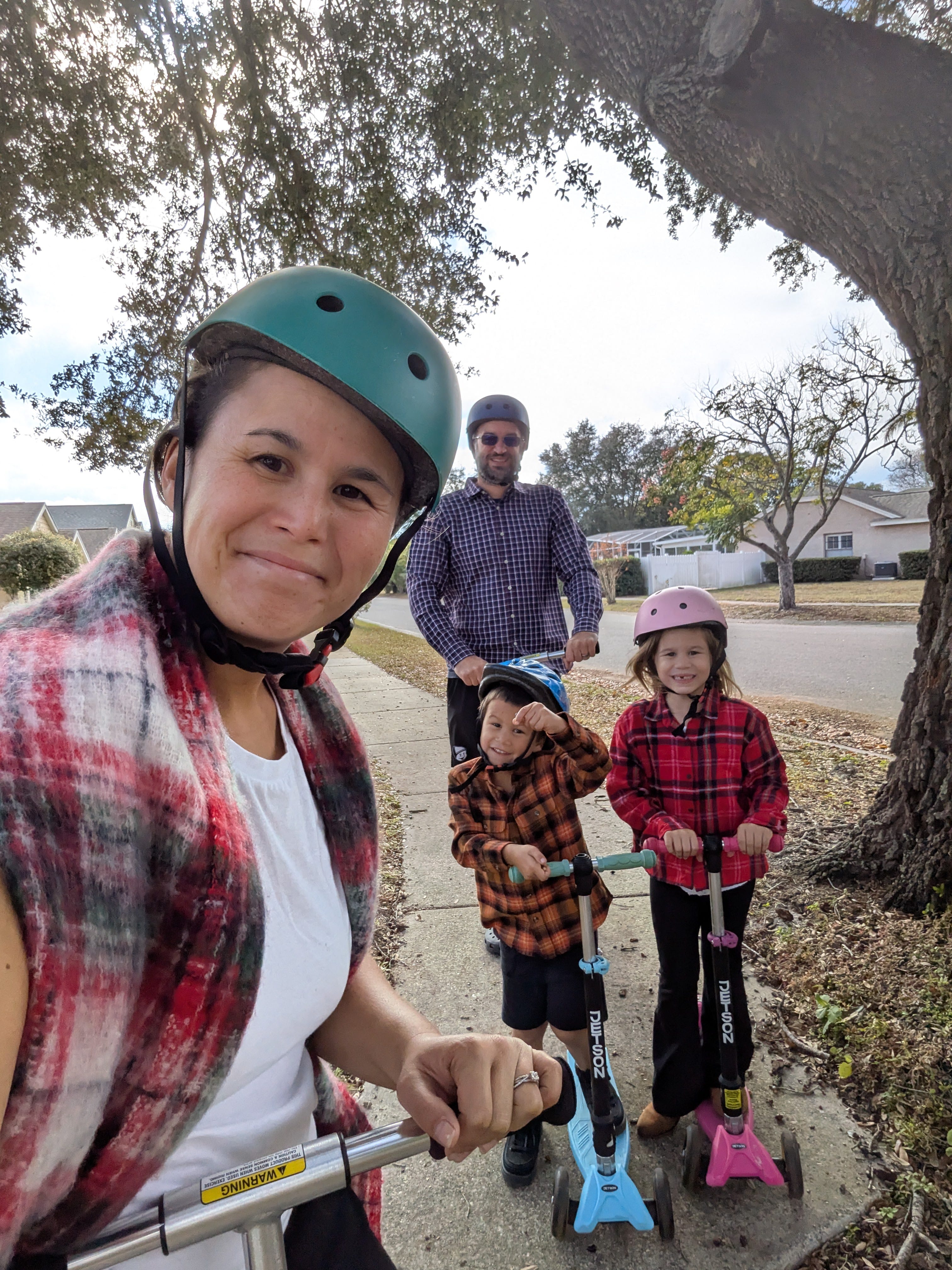
Talking about shame and hiding… then remembering God actually invites us out to live again. This is me doing exactly that—scootering with my favorite people, in my happy place.
Praise Jesus. Blessed day.